Smart Routing
The most expensive part of an agent is usually the LLM call. Frontier models can cost 30–100× more per token than small models, yet many systems send every request to the most capable model by default. Smart routing reverses that default: use the cheapest model that can handle the request, and escalate only when the request proves complex. It assumes a portfolio of models has already been chosen; for how to decide between API, self-host, and hybrid deployments, see Model Selection.
Why routing is not a minor optimization
A simple lookup — "How much is a latte?" — does not need a frontier model. A multi-factor planning request — "Plan the team retro order for five people with allergies, a budget, and weather in mind" — might. When both go to the same expensive endpoint, the cheap request subsidizes the expensive one.
Berkeley's RouteLLM formalized this as a principled routing problem. On public benchmarks, learned routers cut costs by 35–85% while retaining roughly 95% of the strong model's quality. Anyscale's follow-up work shows similar results: a fine-tuned causal classifier routing between GPT-4 and an open-source model can reduce cost by 30–70% at a fixed quality floor.
As of 2026, the frontier-to-small price spread is roughly 20–50× per token [CalibreOS, 2026]. Empirical observations from FrugalGPT and RouteLLM suggest that 40–70% of production queries can be served by the cheap model with no detectable quality loss, 20–30% require frontier capability, and 10–20% fall into an ambiguous middle that benefits from cascade verification [CalibreOS, 2026]. Routing is now the highest-impact cost lever in LLM serving.
The cost-quality Pareto frontier
Routing is a constrained optimization: minimize cost subject to a quality floor. Without an explicit floor, "save money" silently becomes quality regression [CalibreOS, 2026]. Define the floor per intent category:
| Intent | Example quality floor |
|---|---|
| Extraction | ≥ 92% schema accuracy |
| Reasoning | ≥ 88% correct on verified answers |
| Summarization | ≥ 4.0 / 5 on judge eval |
| Chat | Human-equivalent response rate ≥ threshold |
The Pareto frontier is the set of (cost, quality) points no model dominates. A router picks the point on that frontier that satisfies the floor with the lowest expected cost.
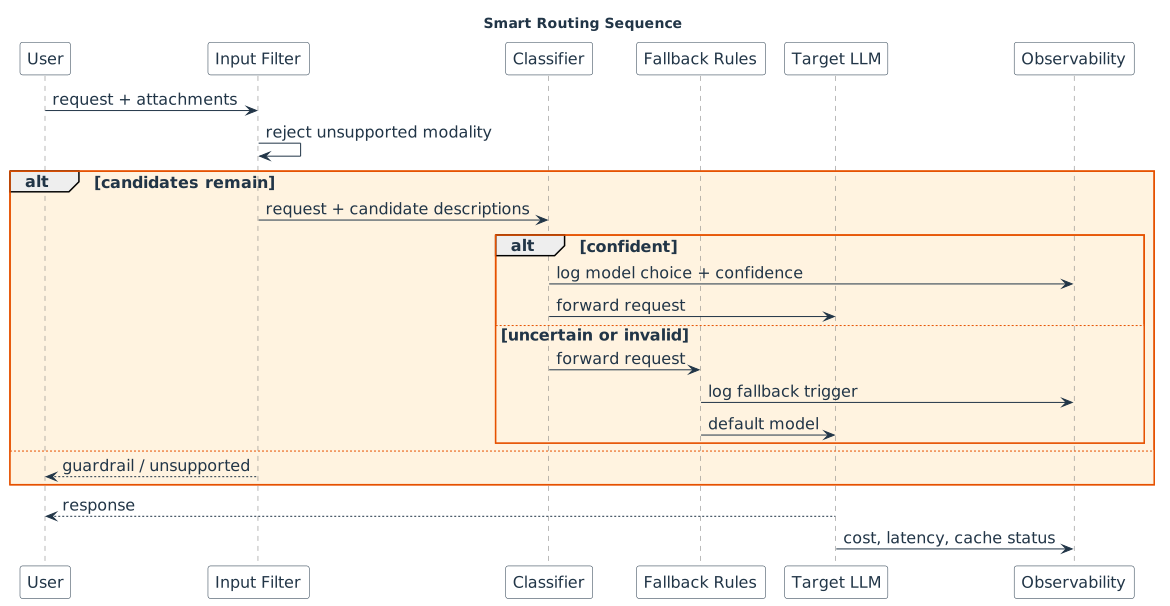
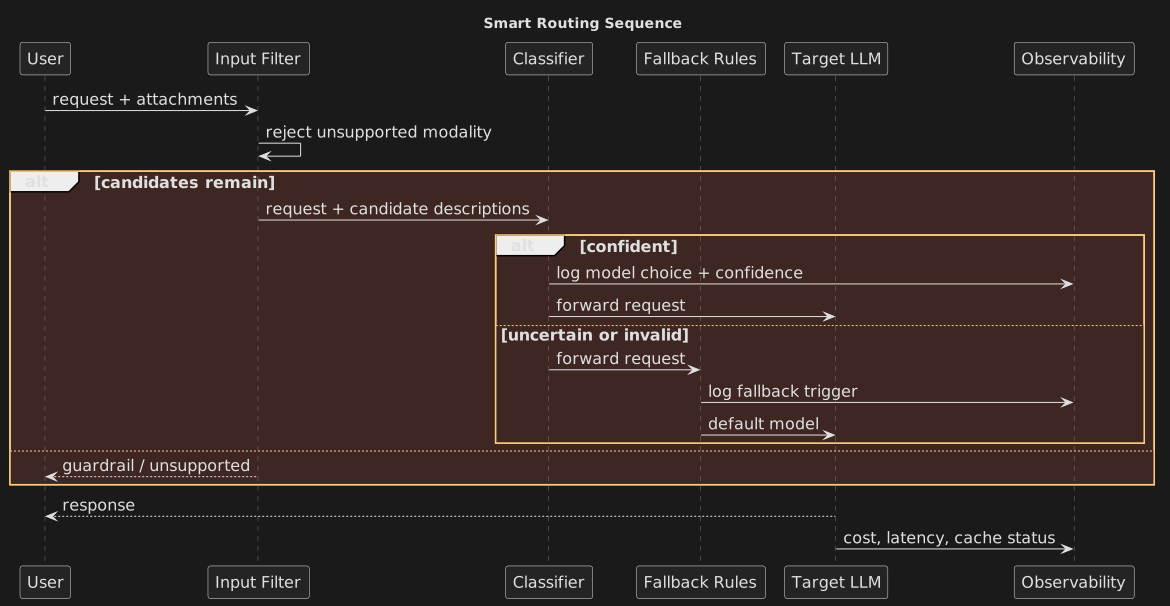
A three-step router
A production router is rarely a single model call. It is a small pipeline:
- Input-type filter. Reject or short-circuit by modality. If the input is an image, only models with vision capability are candidates. If it is a banned topic, route straight to a guardrail response.
- Classifier. A small model or fine-tuned classifier reads the request and predicts the cheapest adequate target model. The classifier is the only non-deterministic stage; its prompt contains concise capability descriptions of every candidate model.
- Fallback rules. If the classifier is uncertain, slow, or returns an invalid choice, deterministic rules take over: default to a safe model, or route by keyword/regex.
| Stage | Deterministic? | Cost | Purpose |
|---|---|---|---|
| Input-type filter | Yes | Negligible | Eliminate impossible candidates early |
| Classifier | No | Cheap LLM | Choose the cheapest capable model |
| Fallback rules | Yes | Negligible | Guarantee a valid route |
Model descriptions matter
The classifier's accuracy depends on the quality of the candidate descriptions it is given. A good description does not list every benchmark; it states what the model is for in your domain:
- Small chat model: fast, cheap, good for factual lookups, short answers, and structured extraction from clear context.
- Coding model: strong at reasoning over code, diffs, and architecture decisions; slower and more expensive.
- Vision model: required for image, diagram, or PDF understanding.
When you add fine-tuned or domain-specialized models, the router can also increase quality by matching the right specialist to the right request.
Cascades and confidence gating
A cascade tries the cheap model first and escalates only when a verifier is unsure [CalibreOS, 2026]. This avoids classifier latency at the cost of occasional extra upstream calls. Cascades work best when there is a cheap, reliable verification signal:
- Code generation: unit tests.
- Math: answer checkers.
- Extraction: schema validators.
- Open-ended chat: expensive judge or reward model; often not worth routing unless volume is huge.
Confidence gating means the classifier's probability should be calibrated: a score of 0.9 should mean roughly 10% error on that route [CalibreOS, 2026]. Uncalibrated classifiers produce either over-confident misroutes or under-confident waste. Shadow traffic is the safe way to recalibrate: send 1–5% of queries to both the routed and gold-route models and compare outcomes.
The hidden cost: KV-cache switching
Routing gains can be erased by cache mechanics. Most providers cache the prefix of a long conversation; switching the model in the middle of a session often breaks that cache. The cheaper model may now cost more than continuing the cached expensive model.
The rule is: measure the full cost, not just the per-call price. Track:
- Cost per routed request by model.
- KV-cache hit rate per session.
- Cost delta caused by switching mid-dialog.
- Prompt-cache hit rate and effective discounted price.
Routing without these metrics is hope, not engineering.
Failure modes
| Failure mode | Symptom | Mitigation |
|---|---|---|
| Router drift | Quality gap grows over time | Shadow traffic, periodic retraining on recent traffic |
| Uncalibrated confidence | Classifier score does not match error rate | Platt scaling or isotonic regression on held-out set |
| Cascade tail latency | Worst-case latency is sum of all hops | Set a per-hop timeout and fallback to frontier |
| Cache-breaking switch | Mid-session model switch costs more than saved | Cache-aware routing, full-session cost accounting |
| Training-serving skew | Router trained on old model pool or old traffic | Regenerate routing dataset when models or traffic shift |
| Overly aggressive cost saving | Frequent escalation or user-visible quality drops | Raise quality floor, retrain with class weights |
Observability
Every routing decision should be observable:
- Which model was chosen and why.
- Confidence score from the classifier.
- Latency and cost of the chosen route.
- Whether the fallback rule triggered.
- Routed-vs-gold quality gap on shadow traffic.
This data feeds back into the classifier: retrain or adjust descriptions when the router consistently misroutes a class of requests.
Design principles
- Fail cheap, then escalate. Start with the cheapest viable model; only re-route if quality checks fail.
- Cache-aware routing. Do not switch models mid-session unless the saved tokens outweigh the lost cache.
- Observable decisions. Record choice, confidence, cost, and outcome for every request.
- Calibrated confidence. A classifier score is a probability, not a rank.
- Explicit quality floor. Constrain cost minimization by intent category.
- Shadow traffic for changes. Router changes are silent quality changes; verify them before full rollout [CalibreOS, 2026].
Deeper dive: routing requests to the right model
As of 2026, the dominant design pattern is to treat the router as a cost-quality gate rather than a single classifier. Production teams report 40–85% bill reductions after moving from a one-size-fits-all frontier endpoint to a routed portfolio, because the capability spread between the cheapest usable model and a frontier model has grown to roughly 100× [Digital Applied, 2026]. The decision is not only about which model is smarter; it is about which model is smart enough for this specific request. Most enterprise traffic falls into commodity categories — intent classification, entity extraction, structured JSON, FAQ lookup, template summarization — that do not need frontier reasoning [LeanLM, 2026]. Routing makes the price paid track the actual difficulty of the task.
Three architectural patterns have emerged, each with different data and latency requirements. Confidence-based cascading tries the cheapest model first and escalates only if a verifier or confidence score is below threshold; it needs no labeled data and captures savings immediately. Pre-inference classification trains a lightweight model to predict the right target before any LLM call; it is cheaper per request than a cascade but requires representative labeled examples. Embedding-based routing matches a query to historical queries with known best-model assignments; it improves as production data accumulates but needs a fallback for cold-start shapes [LeanLM, 2026]. In latency terms, rule-based routing adds under 1 ms, embedding lookup about 5 ms, and learned classifiers 50–100 ms — all small against typical inference latencies of 500–2,000 ms [Digital Applied, 2026].
The real production risk is silent quality regression, not router overhead. Cheaper models can produce plausible but subtly degraded answers that surface as customer tickets days later, so a pre-merge eval gate of 50–500 representative cases is the safeguard that earns the savings safely [Digital Applied, 2026]. Mature routers also fold in policy constraints — per-customer budgets, latency SLAs, data-residency rules, and customer tier ceilings [LeanLM, 2026]. Policy sets the envelope; the difficulty classifier decides where inside that envelope each query lands.
| Approach | When to use | Latency / cost note |
|---|---|---|
| Cascade | No labeled data, mixed query stream | May call a second model; easiest to deploy |
| Pre-inference classifier | High volume, stable task mix | Single extra call; needs labeled examples |
| Embedding-based | Diverse queries with rich history | ~5 ms lookup; needs fallback for cold starts |
References
- CalibreOS. "LLM Router and Model Cascade: Cost-Aware Query Routing at Production Scale." 2026. https://www.calibreos.com/learn/genai-llm-router
- Chen, B., Zaharia, M., Zou, J. "FrugalGPT: How to Use Large Language Models While Reducing Cost and Improving Performance." 2023. https://arxiv.org/abs/2305.05176
- Digital Applied. "LLM Model Routing in 2026: Cost-Quality Optimization." 2026. https://www.digitalapplied.com/blog/llm-model-routing-2026-cost-quality-optimization-engineering-guide
- LeanLM. "LLM Model Routing: Cheapest Capable Model Per Query." 2026. https://leanlm.ai/blog/llm-model-routing
- Ong, I., et al. "RouteLLM: Learning to Route LLMs with Preference Data." UC Berkeley / Anyscale / Canva. https://sky.cs.berkeley.edu/project/routellm/
- Anyscale. "LLM Router: Train and Deploy State-of-the-Art LLM Routers." https://github.com/anyscale/llm-router
- Xue, R., et al. "R2-Router: A New Paradigm for LLM Routing with Reasoning." arXiv:2602.02823, 2026. https://arxiv.org/abs/2602.02823
- Li, Z., et al. "LLMRouterBench: A Massive Benchmark and Unified Framework for LLM Routing." arXiv:2601.07206, 2026. https://arxiv.org/abs/2601.07206