Pipeline
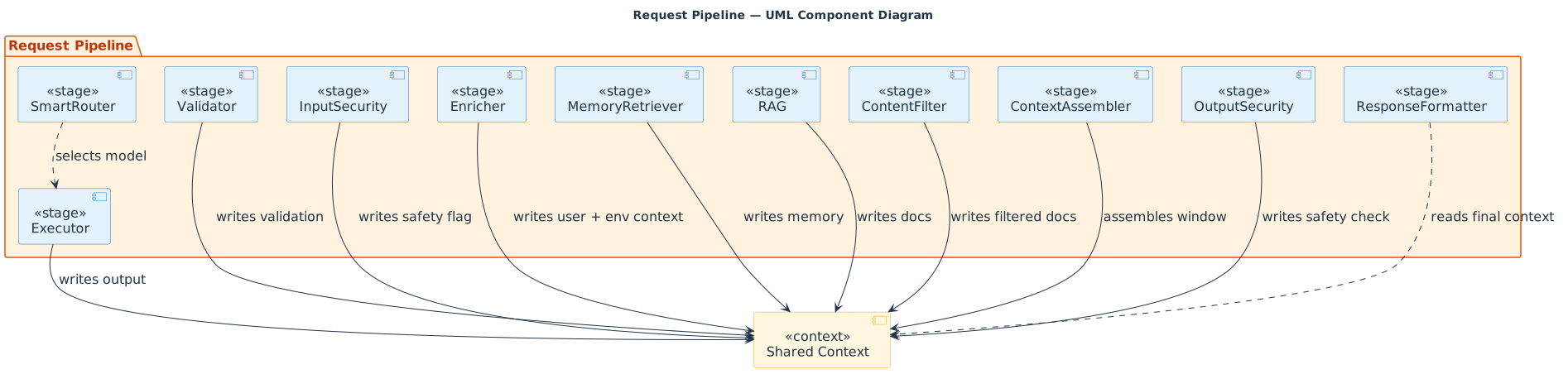
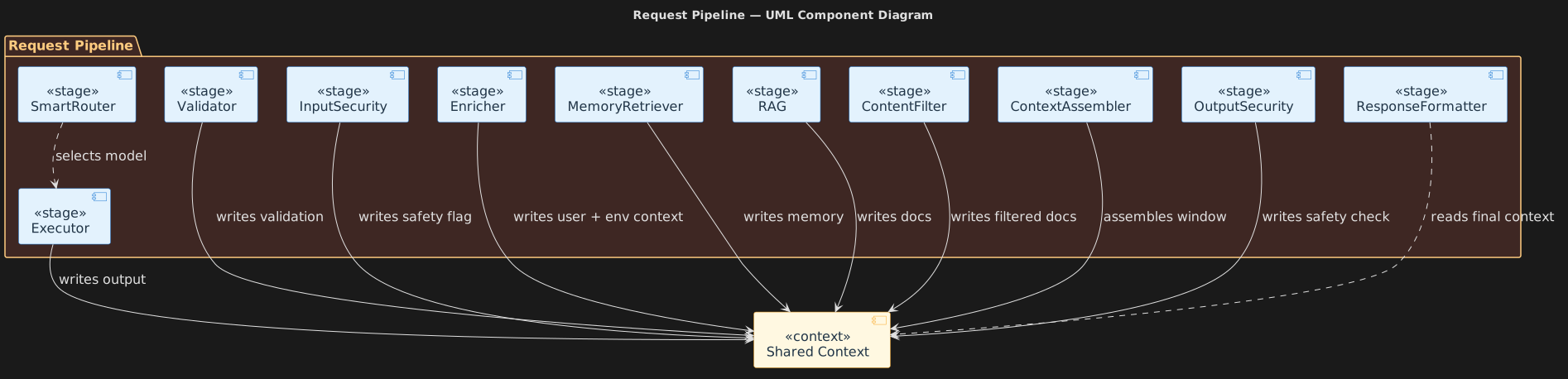
Every agentic system — whether a workflow or an agent — processes requests through a pipeline. The pipeline builds the context window that the LLM eventually sees.
Pipeline as a bloodstream
Each stage reads from a shared context, adds its results, and passes it forward. The final stage, context assembly, turns the accumulated data into the actual prompt. A good pipeline follows two rules:
- Fail fast: cheap checks first, expensive LLM call last.
- Single responsibility: each stage owns one concern.
Stages
| Stage | Purpose | Example guard |
|---|---|---|
| Validation | Reject malformed, empty, or unsupported input. | One regex can save $2,500/month on a million requests. |
| Input security | Detect prompt injection, PII leakage, impersonation. | Run before any tool or LLM call. |
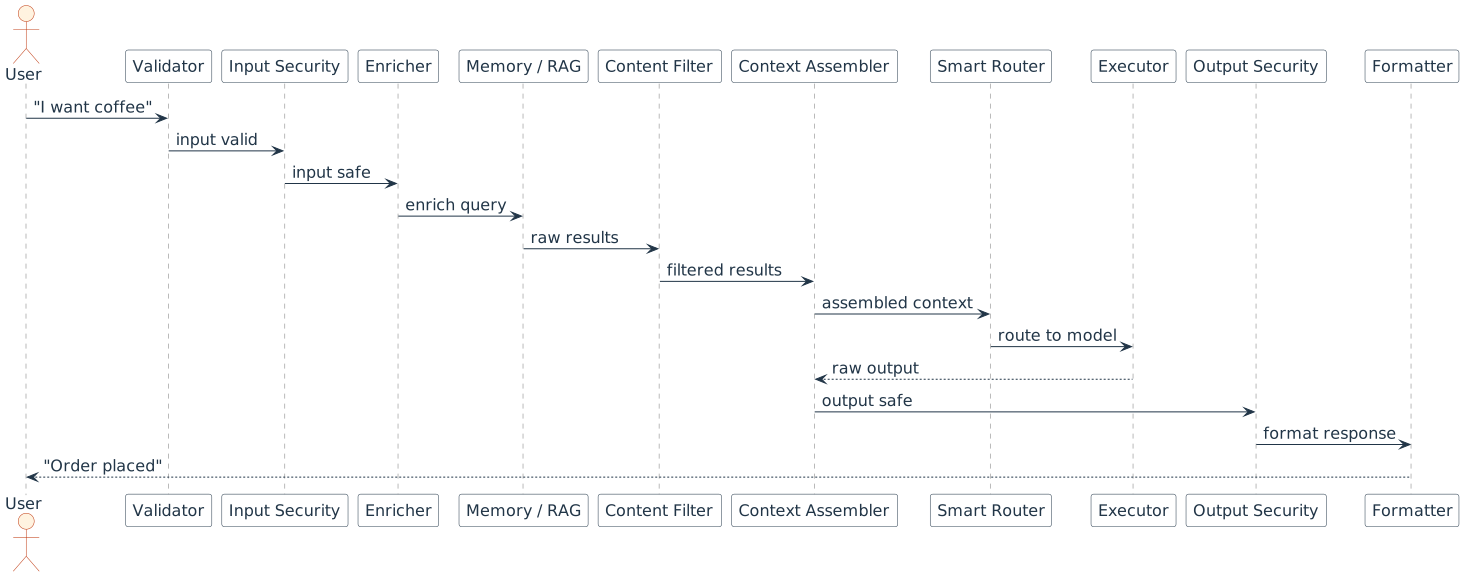
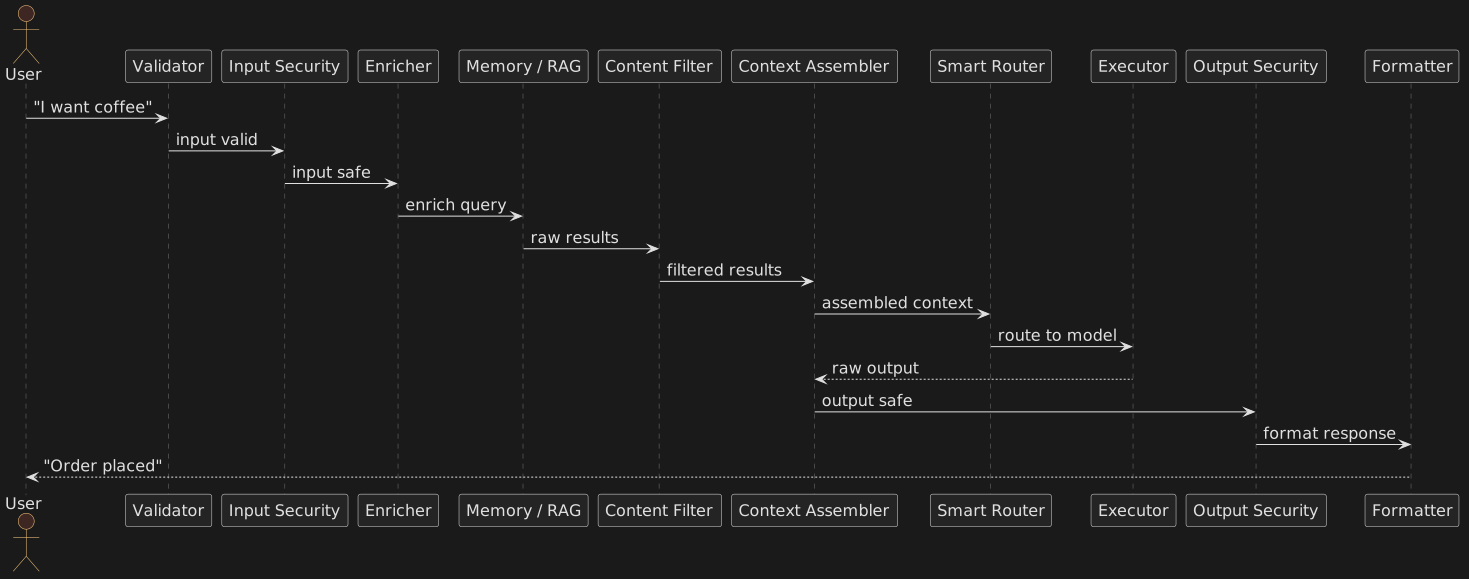
| Query enrichment | Add user profile, session, and environment context. | "I want coffee" becomes "User wants coffee; team meeting in 1 hour." |
| Memory / RAG retrieval | Pull user preferences and domain knowledge. | Filter results for quality and safety. |
| Content filtering | Verify retrieved data is clean and relevant. | Detect injection through documents. |
| Context assembly | Build the final prompt within the token budget. | Sliding window, summarization, or compaction. |
| Smart routing | Select model and reasoning mode. | Cheap model for simple queries; reasoning for complex ones. |
| Generation | The LLM call. | In an agent, this starts the loop. |
| Output security | Check response for PII, system-prompt leaks, off-topic content. | Cheap secondary LLM or rule-based filter. |
| Post-processing | Format, validate JSON, finalize. | Always validate returned JSON. |
Workflow vs agent pipelines
In a workflow pipeline, the sequence is linear. Some stages may have local loops — for example, output security sends a response back for rephrasing — but the developer decides where to loop.
In an agent pipeline, the generation stage contains a loop. The LLM decides whether to call another tool. The pre-loop stages (validation, security, enrichment) still run once; the post-loop stages (output security, formatting) run once at the end.
Context assembly
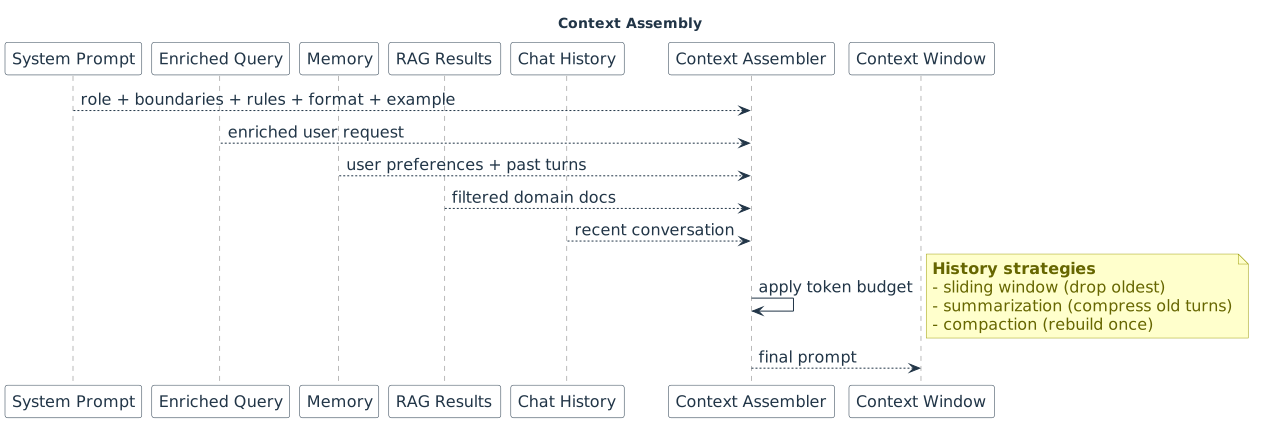
Context assembly is the stage that turns accumulated data into a prompt. It has four inputs:
- System prompt — role, boundaries, rules, format, example.
- User query — enriched with context.
- Memory — user preferences and history.
- RAG results — domain documents.
All four compete for a token budget. Anthropic calls context engineering "the natural progression of prompt engineering": it is the practice of curating the smallest set of high-signal tokens that maximize the likelihood of the desired outcome [Anthropic, 2025]. Redis notes that models use information at the beginning and end of the input far better than information in the middle, so place decision-critical facts at the edges and give every section a hard token budget [Redis, 2026].
If the window is too large, use one of these strategies:
- Sliding window: keep the last N messages, drop older ones.
- Summarization: compress older turns into a summary.
- Compaction: collapse the entire history into a new, dense context once.
For long-horizon tasks, prefer structured note-taking (agent writes persistent notes) and sub-agent architectures that return only condensed summaries, rather than dumping everything into the main context [Anthropic, 2025].
KV cache and context mutations
During an agent loop, the context should be append-only. Every mutation in the middle invalidates the KV cache and forces the provider to reprocess the entire prefix. Manus calls KV-cache hit rate the single most important metric for a production agent: with Claude Sonnet, cached input tokens cost $0.30/MTok while uncached tokens cost $3/MTok, a 10× difference [Manus, 2025].
Common cache killers:
- A timestamp injected into the system prompt.
- Modifying a previous tool result.
- Non-deterministic JSON key ordering.
- Dynamically adding or removing tool definitions mid-iteration.
When the context grows beyond the budget, reassemble the whole window once rather than mutating it every iteration. Better yet, use just-in-time references (file paths, stored queries, URLs) that the agent loads on demand instead of pre-loading everything up front [Anthropic, 2025].
Security layers
Input and output security are not optional. Hossain's production guardrail stack runs validation, PII detection, injection classification, the LLM, an output filter, and a response gate as independent layers [Hossain, 2026]. Microsoft FIDES adds deterministic information-flow control: every content item carries integrity (trusted/untrusted) and confidentiality labels, and policies are enforced before a sensitive tool runs [Microsoft, 2025].
| Layer | What it catches | Typical latency |
|---|---|---|
| Schema validation | Malformed input, bad parameters | <2 ms |
| PII redaction (inbound) | Credit cards, SSNs, emails pasted into prompts | 15–80 ms |
| Prompt-injection classifier | [SYSTEM OVERRIDE], hidden instructions in user input or retrieved docs |
30–120 ms |
| Tool-output trust boundary | Untrusted data driving privileged tools | 0 ms (policy check) |
| Output PII / policy filter | Hallucinated or leaked sensitive data | 60–250 ms |
| Schema gate (tool args) | Invalid function-call arguments | <5 ms |
Metrics per stage
Treat each stage as an observable component:
| Stage | Metrics |
|---|---|
| Validation | Reject rate, latency, top rejection reasons |
| Input security | Injection score distribution, false-positive rate |
| Enrichment | Cache hit rate for user profile / session lookups |
| Retrieval | Recall@k, MRR, contaminated/unsafe result rate |
| Context assembly | Tokens per section, budget overflow events, KV-cache hit rate |
| Smart routing | Model distribution, cost per request class |
| Generation | Latency, token count, stop reason |
| Output security | PII leak rate, policy violation rate |
| Post-processing | JSON parse failure rate, formatting errors |
Design principles
- Fail fast first: validation and security are cheap; do them before any LLM call.
- Single responsibility per stage: do not mix format validation with injection detection. They have different owners and failure modes.
- Configurable depth: start with validation, security, generation, and post-processing. Add enrichment, RAG, content filtering, and smart routing when data shows you need them.
- Context is a budget: give system prompt, history, retrieved docs, and query each a hard token allocation; do not let one section silently crowd out the others.
- Trust labels beat defensive prompts: deterministic provenance checks are stronger than asking the model to "ignore the above" [Microsoft, 2025].
Deeper dive: request pipeline patterns at scale
At high volume, the pipeline becomes a context-building funnel rather than a linear script. Each stage reads from a shared context object, appends its results, and passes the object forward without rewriting earlier state [Zalesov, 2026]. This append-only discipline is not just a cleanliness choice: mutating the prefix invalidates the KV cache and forces the provider to reprocess expensive tokens. The production consensus is therefore to push cheap, deterministic work as far left as possible — rate limiting, schema validation, bot detection, prompt-injection classification, and PII screening all run before the first model call [Zalesov, 2026].
Once the request is clean and enriched, the next failure mode is usually not the prompt but what the model is allowed to see. A production context pipeline rewrites short or pronoun-heavy queries, over-fetches with hybrid dense-and-sparse retrieval, reranks candidates for precision, deduplicates near-identical or contradictory chunks, and only then assembles the final window under an explicit token budget [Singh, 2026]. The assembly stage is the highest-leverage place to intervene: place decision-critical facts at the start or end of the window to exploit positional bias, give every section a hard token allocation, and treat "concatenate everything and hope" as the default failure mode [Singh, 2026].
For agents, the same stages apply but the loop changes the contract. Validation, security, and enrichment still run once before the loop; inside the loop, retrieval and memory become tool calls whose results are appended to the thread [Zalesov, 2026]. There is no fixed assemble-then-call step — the context grows incrementally — so production agents cap iterations, total tokens, and per-tool calls to prevent runaway cost and compounding hallucinations [Zalesov, 2026].
Common context-assembly failure modes and the stage that prevents them:
| Failure mode | Preventive stage |
|---|---|
| Vague or pronoun-heavy query | Query rewriting / enrichment |
| Exact-match IDs lost in semantic retrieval | Hybrid retrieval |
| Contradictory or duplicate documents in the window | Reranking + deduplication |
| Critical fact buried in the middle | Position-aware context assembly |
| Silent history bloat crowding out retrieved docs | Hard per-section token budget |
| Re-running the full pipeline for near-identical requests | Reuse / semantic cache |
References
- Anthropic. "Building Effective AI Agents." Dec 2024. https://www.anthropic.com/engineering/building-effective-agents
- Anthropic. "Effective Context Engineering for AI Agents." Sep 2025. https://www.anthropic.com/engineering/effective-context-engineering-for-ai-agents
- Hossain, M. S. "AI Agent Guardrails in Production: Input Filtering, PII Redaction & Prompt Injection Defense." Mar 2026. https://mdsanwarhossain.me/blog-ai-agent-guardrails.html
- Manus. "Context Engineering for AI Agents: Lessons from Building Manus." https://manus.im/en/blog/Context-Engineering-for-AI-Agents-Lessons-from-Building-Manus
- Microsoft. "Agent Security with FIDES." Microsoft Learn, 2025. https://learn.microsoft.com/en-us/agent-framework/agents/security
- Redis. "Context Assembly: Building the Prompt the Model Sees." Redis blog, Jul 2026. https://redis.io/blog/context-assembly-building-the-prompt-the-model-sees/
- Singh, H. "Context Engineering Is Replacing Prompt Engineering: Building Production Context Pipelines for LLM Apps." DEV Community, Jul 2026. https://dev.to/hrsvd/context-engineering-is-replacing-prompt-engineering-building-production-context-pipelines-for-llm-14m8
- Zalesov, A. "A Practical Memo on Building LLM Agents." May 2026. https://medium.com/@zallesov/a-practical-memo-on-building-llm-agents-cc5179cb2e50